Bible story
All Saints' Day: Revelation 7:9 and Titian's John on Patmos
All Saints' Day on November 1 honors all the saints, known and unknown, and one of its traditional readings is John's vision in Revelation 7 of a multitude no one could count, from every nation, standing before the throne. Titian's ceiling painting at the National Gallery of Art shows John on the island of Patmos as his visions begin.
Updated
The painting
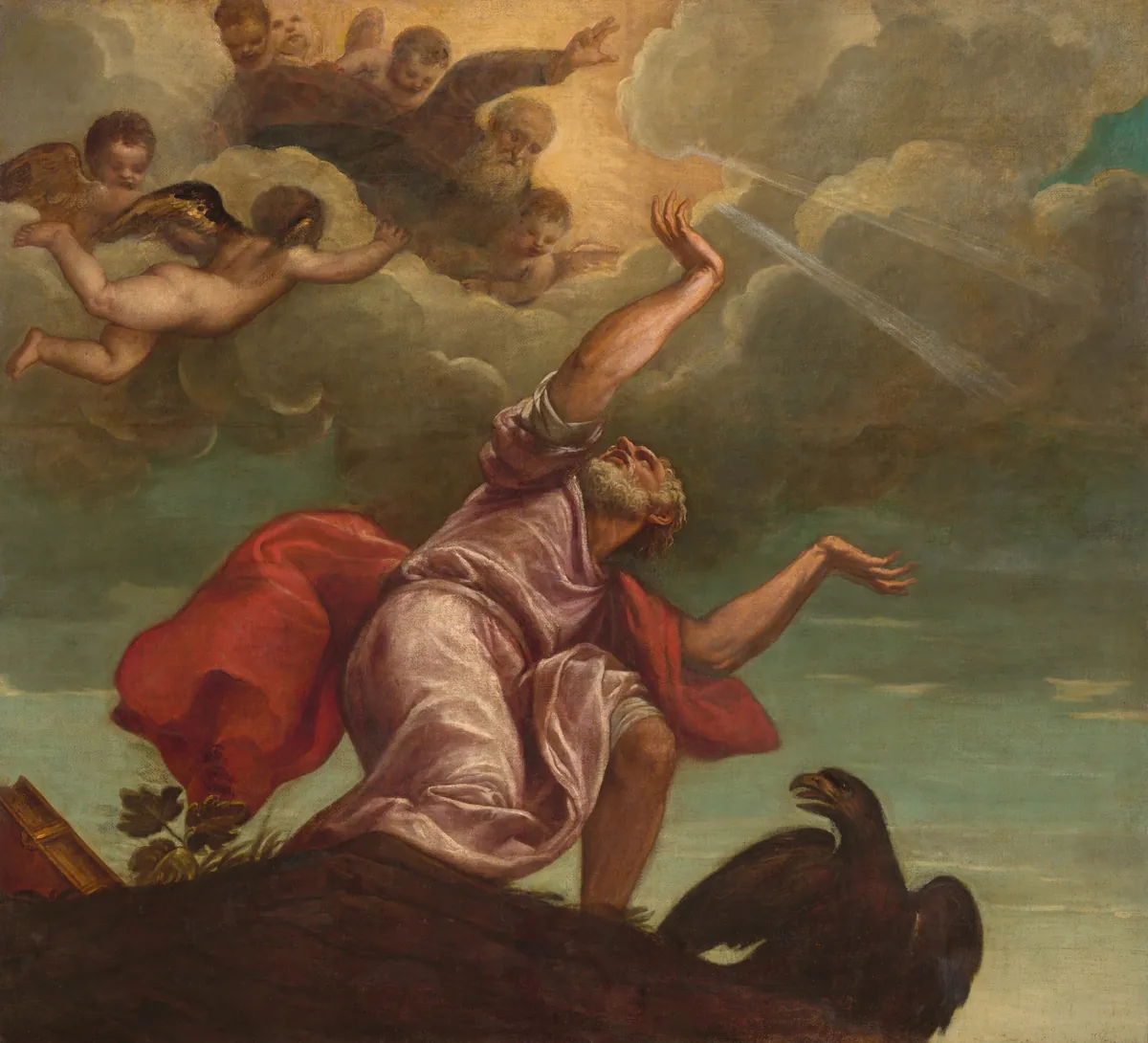
Titian and workshop
Saint John the Evangelist on Patmos, c. 1553/1555
Oil on canvas
National Gallery of Art, Washington, DC
Public domain (NGA Open Access) · museum record · credits
Accession 1957.14.6
Revelation 7:9
Painted for the ceiling of the Scuola di San Giovanni Evangelista in Venice, which is why it is seen from below.
After this I beheld, and, lo, a great multitude, which no man could number, of all nations, and kindreds, and people, and tongues, stood before the throne, and before the Lamb, clothed with white robes, and palms in their hands;
Revelation 7:9 (KJV)
The story
The Book of Revelation is written as a series of visions given to John while he was on the island of Patmos (Revelation 1:9). In chapter 7, after a list of the tribes of Israel, he looks again and sees a crowd too big to count, from every nation and language, dressed in white and holding palm branches. An elder explains that these are people who have come through great hardship (Revelation 7:14).
The context
All Saints' Day, November 1, remembers every saint, not only the famous ones with their own feast days. In the Catholic Church in the US it is a solemnity, and Revelation 7 is read at Mass that day. Many Protestant churches, including Anglican, Lutheran and Methodist congregations, also keep All Saints' on November 1 or the Sunday after. The verse fits the day because the crowd has no names: it is everyone.
Look at the painting
The painting does not show the crowd itself. It shows the moment the visions begin: John on a rocky height, twisting back with arms wide, an eagle (his traditional symbol) beside him, and God appearing in the clouds above. Titian designed it to be seen overhead on a ceiling, so the figures are steeply foreshortened. If you stand under it, the vision seems to open above you.
Sources
Verse text from public-domain translations, quoted exactly with the reference. Paintings are named with their museum. Candlelit Bible is independent and not affiliated with any church or museum.