Bible story
The Prodigal Son Explained: Luke 15 and Murillo's Painting
In Luke 15, Jesus tells of a younger son who wastes his inheritance and comes home hoping only to be a hired servant, and his father runs to meet him before he can finish his apology. Murillo's painting at the National Gallery of Art in Washington shows the embrace, with the new robe and ring already on the way.
Updated
The painting
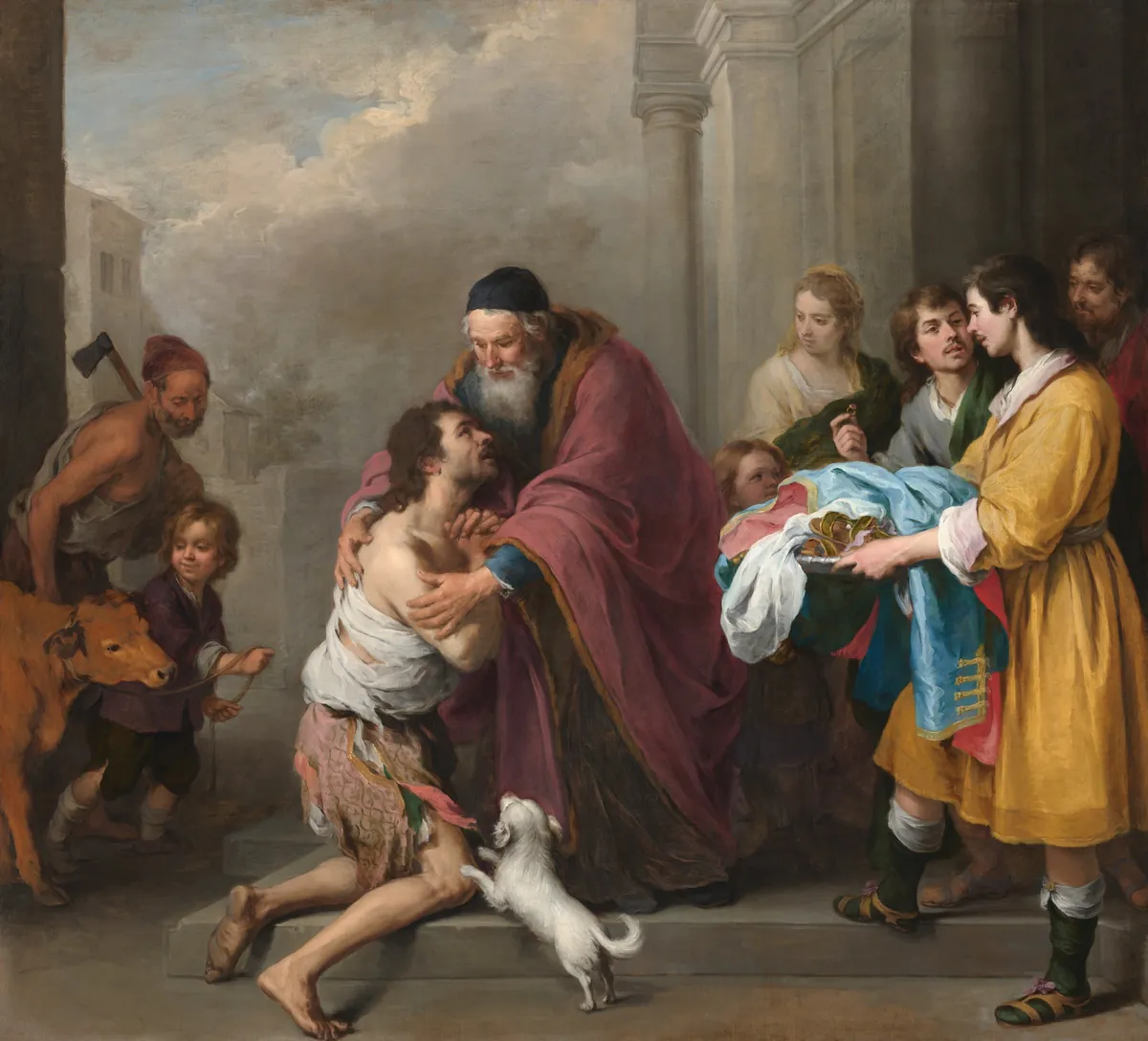
Bartolomé Esteban Murillo
The Return of the Prodigal Son, 1667/1670
Oil on canvas
National Gallery of Art, Washington, DC
Public domain (NGA Open Access) · museum record · credits
Accession 1948.12.1
Luke 15:20
One of a series Murillo painted for the Hospital of Charity (Hermandad de la Caridad) in Seville.
And he arose, and came to his father. But when he was yet a great way off, his father saw him, and had compassion, and ran, and fell on his neck, and kissed him.
Luke 15:20 (KJV)
The story
A father has two sons. The younger asks for his share of the inheritance early, travels to a far country and spends it all. When a famine comes he ends up feeding pigs and envying their food. He decides to go home and say he is no longer worthy to be called a son, only a hired servant. The verse above is what happens next: the father sees him from far off and runs.
The context
Luke 15 opens with religious leaders complaining that Jesus "receiveth sinners, and eateth with them" (Luke 15:2). He answers with three stories in a row: a lost sheep, a lost coin and a lost son. The third is the longest, and it ends not with the younger son but with the older brother, who refuses to join the celebration. The story stops before we learn whether he goes in.
Look at the painting
Murillo shows the moment just after the verse. The son kneels in rags; the father wraps him in his arms. To the side, servants bring the "best robe" and the ring the father asks for in Luke 15:22, and a fattened calf is led in for the feast. Look at the son's rags next to the clean new clothes being carried in: the whole reversal of the story is in that contrast.
Sources
Verse text from public-domain translations, quoted exactly with the reference. Paintings are named with their museum. Candlelit Bible is independent and not affiliated with any church or museum.